A garage door runs on two vertical tracks and a pair of horizontal ones, and the door's rollers ride inside them. When the tracks are straight, plumb, and parallel, the door travels smoothly and the opener only has to push and pull. When a track is bent, knocked out of plumb, or pushed out of parallel with its partner, the door binds against the steel, the panels scrape, and the whole assembly gets louder. The tricky part is that a track problem and an opener problem can produce symptoms that look alike from the driver's seat: the door stops halfway, reverses, or refuses to move at all. This guide is about recognizing a track problem from the garage floor, understanding what bends tracks in Broward County homes, and running safe tests that separate a track fault from an opener fault. Track straightening and roller work are technician jobs throughout; what follows is about observation and the checks a homeowner can do without touching the door's moving hardware.
What the tracks do, and what "out of alignment" actually means
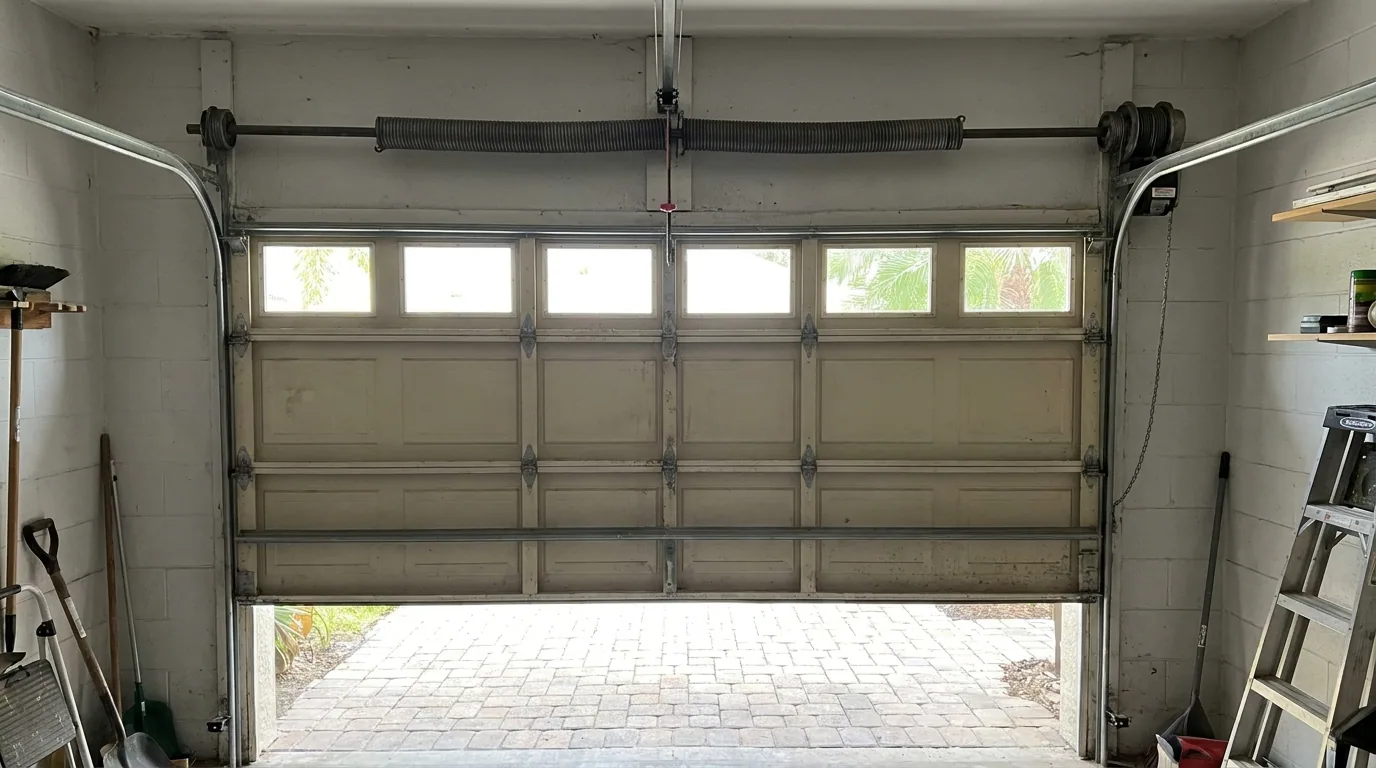
Each side of the door has a vertical track that guides the door up and down, and a curved or angled section that transitions into a horizontal track running back toward the opener. The rollers are mounted on the door's hinges and sit inside the track channel. For the door to travel evenly, the two vertical tracks must be plumb and parallel to each other, spaced so the door fits between them with a little clearance, and mounted securely to the framing.
"Out of alignment" covers several distinct conditions. A vertical track can be knocked out of plumb, so it leans slightly toward or away from the door. A track can be bent inward or outward at a specific point, creating a tight spot the roller has to force its way through. The two tracks can be pushed out of parallel, so the gap between them narrows toward the top or bottom. A track can also pull loose from its mounting brackets, which lets the whole run shift. Each of these produces a different symptom, and none of them is something a homeowner should try to correct by bending steel back into place. A track that has been forced back by hand is rarely straight, and the door's weight and spring tension are still loaded against it.
What you can see and hear from the garage floor
Most track problems announce themselves before the door fails completely. With the garage empty and the door closed, a few observations are safe and useful.
- The door sits crooked. One bottom corner is higher than the other, or the gap along the top of the door is uneven from side to side. A door hanging at an angle can point to a snapped cable, a broken spring, or a bent track, and the technician's inspection separates them.
- The door scrapes or binds at the same point every cycle. A rhythmic scrape or a spot where the door seems to catch is consistent with a tight or bent section of track, though a damaged roller or a loose hinge can produce a similar sound.
- The door is louder than it used to be. A new rattle, a metallic clunk, or a grinding note at the start of a cycle can come from a roller, a hinge, a dry bearing, or a track that has shifted. The location of the noise during the cycle is the best clue, and a technician can trace it.
- The door drifts to one side as it rises. If the door visibly shifts toward one track on the way up, the tracks may no longer be parallel, or a roller may be out of its channel.
- A visible gap between the track and the door frame. Mounting brackets that have pulled away from the wood or masonry are visible from the floor and are worth pointing out when you call.
What you should not do is stand under the door while it operates, reach into the track to feel for a tight spot, or attempt to pry a track back into position. The door is under spring tension at all times, and a track that lets go under load can drop the door.
What bends tracks in South Florida garages
Tracks are galvanized steel, and they do not bend on their own. Something has to push them. The most common cause is impact: a car bumper, a bicycle, a lawn mower, or a stack of stored material leaning against the vertical track. A light bump that the driver barely notices can knock a track out of plumb enough to make the door bind a few inches further up.
The second common cause is a door that has been run while something was wrong with it. A door with a failing spring, a damaged roller, or a hinge that has pulled loose can lurch or shift in the track, and the repeated sideways force gradually works the mounting brackets loose. Older homes in Hollywood and Dania Beach, and newer construction in Weston, Miramar, and Pembroke Pines, all see this pattern; the age of the house matters less than whether the door has been run while binding.
Heat and humidity are part of the picture in Broward County, but the mechanism is worth stating carefully. Wood framing expands and contracts with moisture, and a track bracket screwed into framing that has moved can loosen over time. That is a mounting problem, not a track-bending problem, and it is one reason a track that looks straight can still rattle. If a track has pulled away from the wall, the fix is at the bracket, not in the steel.
Finally, a door that has been hit or has jumped a roller can leave a roller sitting outside the track channel. That is visible from the floor as a roller that is not seated in the channel, and it should be treated as a stop-use condition until a technician reseats it.
Telling a track problem from an opener problem
This is where most homeowners go wrong, because the symptoms overlap. An opener that strains, a door that reverses, and a door that stops halfway can all come from either side of the system. The tests below are safe and require no tools and no contact with the door's moving parts.
Test one: does the door move freely by hand? No, do not try it.
Homeowners are often told to disconnect the opener and lift the door to feel whether it is balanced. Do not do this. The door is heavy, the spring is loaded, and a door that comes off a roller or loses its cable mid-lift can injure you. Instead, note what the door does under normal opener operation. If the opener runs and the door moves a few inches and then stops, or the door feels noticeably heavier in normal use than it used to, that points toward a mechanical bind or a counterbalance problem rather than an opener fault. A technician performs the balance check safely.
Test two: listen to the opener, not the door.
If you press the button and you hear the motor running but the door does not move at all, the opener is turning without transferring motion to the door. A stripped opener gear is one certain cause: the motor spins and the trolley does not travel. A broken spring or a disconnected door arm can produce a similar result, so the technician confirms which by inspecting the drive train and the counterbalance. If the motor runs and the door moves partway and then stops, the opener is working and something is resisting the door, which is consistent with a track bind, a bad roller, or a spring that has lost tension.
Test three: watch the door's path, not its destination.
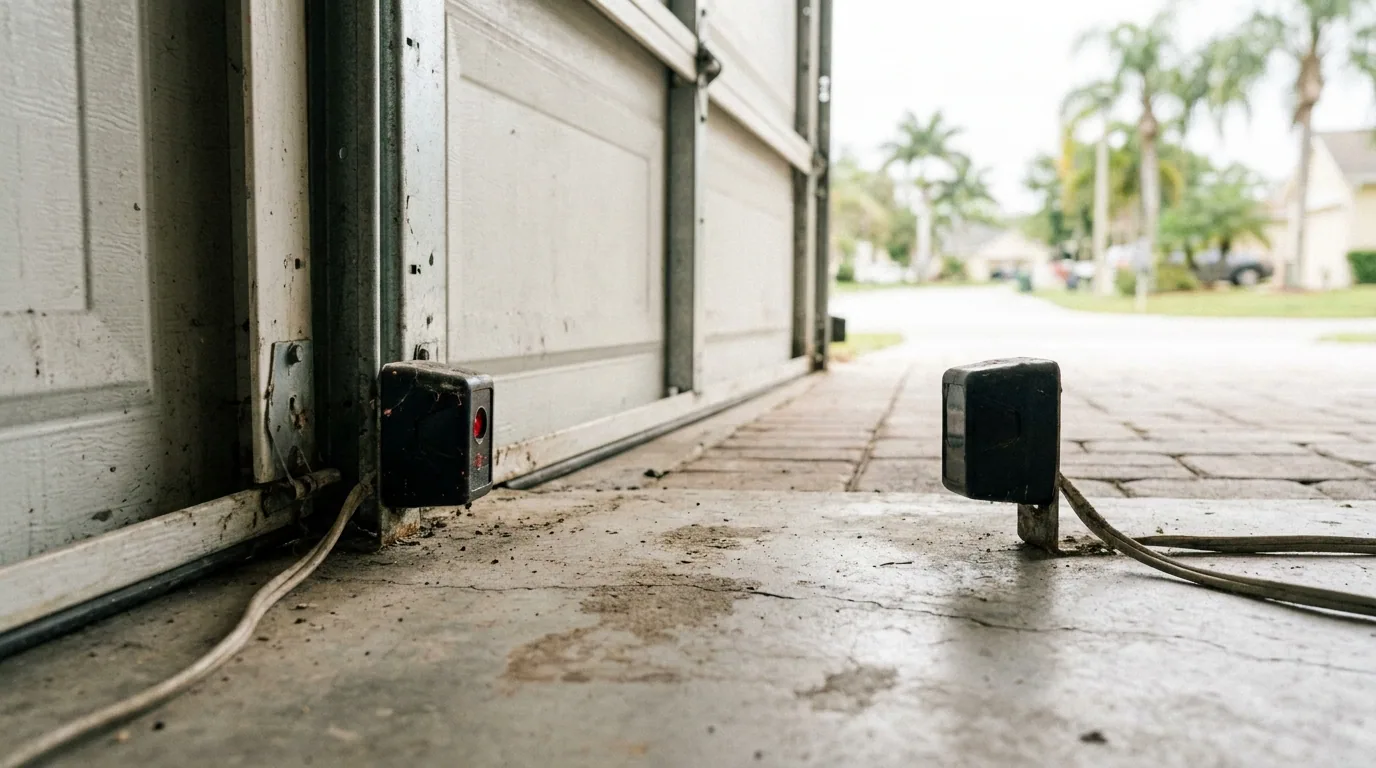
Stand well clear and to the side, and watch the door as it travels. A door that moves smoothly for the first foot and then jerks or slows at the same height every time is telling you where the bind is. A door that reverses before it reaches the floor is showing a travel-limit or force-setting problem, not a track problem, and not a photo-eye problem. The photo-eye is a safety device that reverses a door only while it is closing, and only when the beam is blocked or the sensors are misaligned. It has no role in a door that will not start, opens a little and reverses, or stops short on the way up. If the door reverses on the way down with nothing in the way, the travel limits and force settings are the place to look, and those are adjusted at the opener head, which is technician work.
Test four: check the wall control and the remotes.
If the door does not respond at all, and there is no motor sound, the problem is electrical or in the control, not the track. Confirm the opener has power, try a second remote or the wall button, and note whether the opener's light comes on. A door that responds to the wall control but not the remote points to the remote or its battery. A door that responds to neither points to power or the opener's logic board. None of these involve the tracks, and none of them require you to touch the door.
When to stop using the door and call
Some conditions are safe to observe and schedule a repair. Others mean the door should stay down until a technician arrives. Stop using the door if it is hanging crooked, if a roller is visibly out of its track, if a track has pulled away from the wall, if the door has been hit by a vehicle, or if the door feels substantially heavier than normal in use. In each of those cases the door may be running with reduced support, and another cycle can make it worse.
CrownLift Garage Doors handles track and roller work, spring and cable repair, opener service, and full door replacement across Broward County, including Hollywood, Fort Lauderdale, Hallandale Beach, Dania Beach, Davie, Pembroke Pines, Miramar, Weston, Sunrise, Plantation, Cooper City, Southwest Ranches, West Park, Pembroke Park, Aventura, and North Miami Beach. The company is licensed and insured, and emergency service is available outside regular hours. Weekday hours are 7:00 AM to 8:00 PM, weekend hours are 8:00 AM to 6:00 PM. Reach the office at (877) 897-6132 or service@crownliftgarage.com, or at 2350 NW 66th Ter, Hollywood FL 33024.
The useful habit is to describe what you saw and heard: where in the cycle the door binds, which side it drifts toward, whether the motor runs, and whether the noise is new. That description shortens the diagnosis, and it keeps the work where it belongs, with a technician on the springs, cables, tracks, and opener drive train.