A garage door that will not move is a frustrating thing to walk out to, and the instinct is to assume the worst. In practice, a door that will not budge falls into three broad categories: the opener is not working, a spring has failed, or the opener is not getting power. Each one looks a little different from the outside, and each one calls for a different next step. The good news is that you can sort most of these cases yourself with a few safe observations. Springs, cables, and the opener drive train stay with a technician throughout. What follows is what you can safely check, and how the likely causes are separated.
Start with the simplest question: is anything happening at all?
Before you assume the worst, find out whether the opener is doing anything when you press the button. Stand where you can see and hear the door, press the wall switch, and pay attention to what happens — or does not.
- Nothing at all. No sound, no light, no movement. This points toward a power problem or a dead opener.
- A click or a hum, but no movement. The unit is getting power and trying to run, but the door is not moving. This points toward a mechanical problem or a fault inside the opener.
- The motor runs, the door does not move. You can hear the motor turning, but the door stays put. This is a drive-train symptom.
- The door moves a little and stops or reverses. The opener is working, but something is interrupting the cycle.
Write down which of these you saw. It is the single most useful piece of information you can give a technician, and it narrows the list of causes faster than anything else.
When nothing happens: check the power first
If the opener is completely silent, the first thing to rule out is power. A dead opener and a power problem look identical from the outside, so work from the outlet backward.
Check whether the outlet the opener is plugged into has power. If it is a GFCI outlet, it may have tripped; reset it and see whether the opener comes back. Check the circuit breaker for the garage circuit. If the opener is on a switch, confirm the switch is on. Look at the wall switch itself — a stuck or failed wall switch can make a working opener seem dead.
If the outlet is live and the opener still does nothing, the problem is in the unit. That could be a failed logic board, a bad transformer, or a dead motor. Those are technician work. Do not open the opener housing to investigate; the capacitors inside hold a charge after the power is off.
When the motor runs but the door does not move
This is one of the more diagnostic symptoms a homeowner can report. If you can hear the motor running but the door stays put, the opener is receiving power and trying to work. The question is where the motion is being lost.
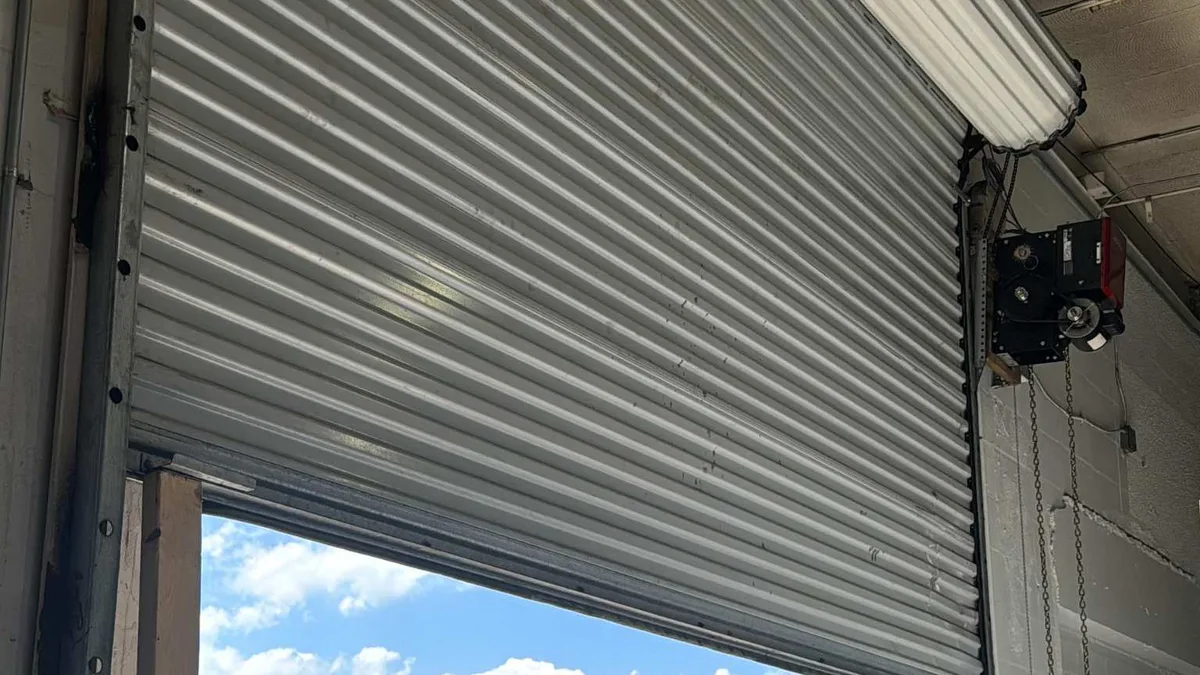
One certain cause is a stripped opener gear. When the gear wears out, the motor turns but the drive train does not engage, so the door does not move. That is a mechanical failure inside the opener, and it is technician work.
Another possibility is that the door is disconnected from the opener. Many openers have a manual release that disengages the door from the drive. If that release has been pulled — sometimes by accident, sometimes by a child — the opener will run without moving the door. Check whether the release cord or handle is in its normal position. Re-engaging it is safe to do with the door fully closed; if you are not sure how, leave it and call.
A third possibility is a broken spring or cable that is holding the door in place. That brings us to the next section.
When the door feels heavier or sits crooked
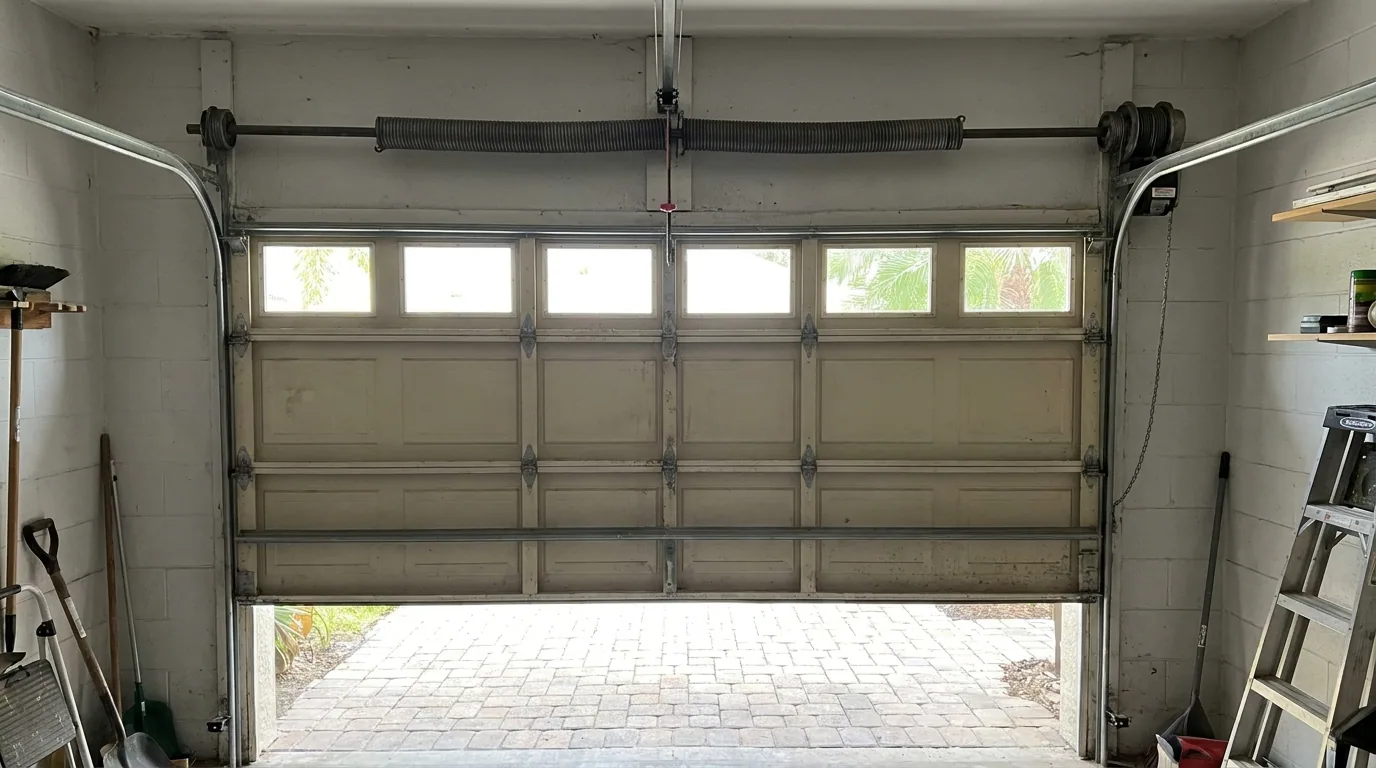
A torsion spring carries the weight of the door. When one breaks, the door suddenly becomes much heavier than it was, and the opener may not be able to lift it. You do not need to lift the door to notice this. You may notice that the door feels heavier than it used to when you use it normally, that it sits crooked in the opening, that there is a gap along the top edge, or that there is a new noise at the start of a cycle.
A broken torsion spring cannot hold the door's weight, so a door with a failed spring will not stay up on its own and may not lift at all. A snapped cable will let the door hang at an angle. A bent track can also make a door bind and sit crooked. These three look similar from the outside, and the test that separates them is a technician's inspection of the springs, cables, and track. Do not try to tell them apart by hand.
If you suspect a spring or cable problem, stop operating the door. Forcing a door with a failed spring can damage the opener and the door itself, and a door that is hanging on one side is not safe to run.
When the door moves and then stops or reverses
A door that starts to move and then stops short or reverses is a different category. The opener is working, and the door is moving, but something is interrupting the cycle.
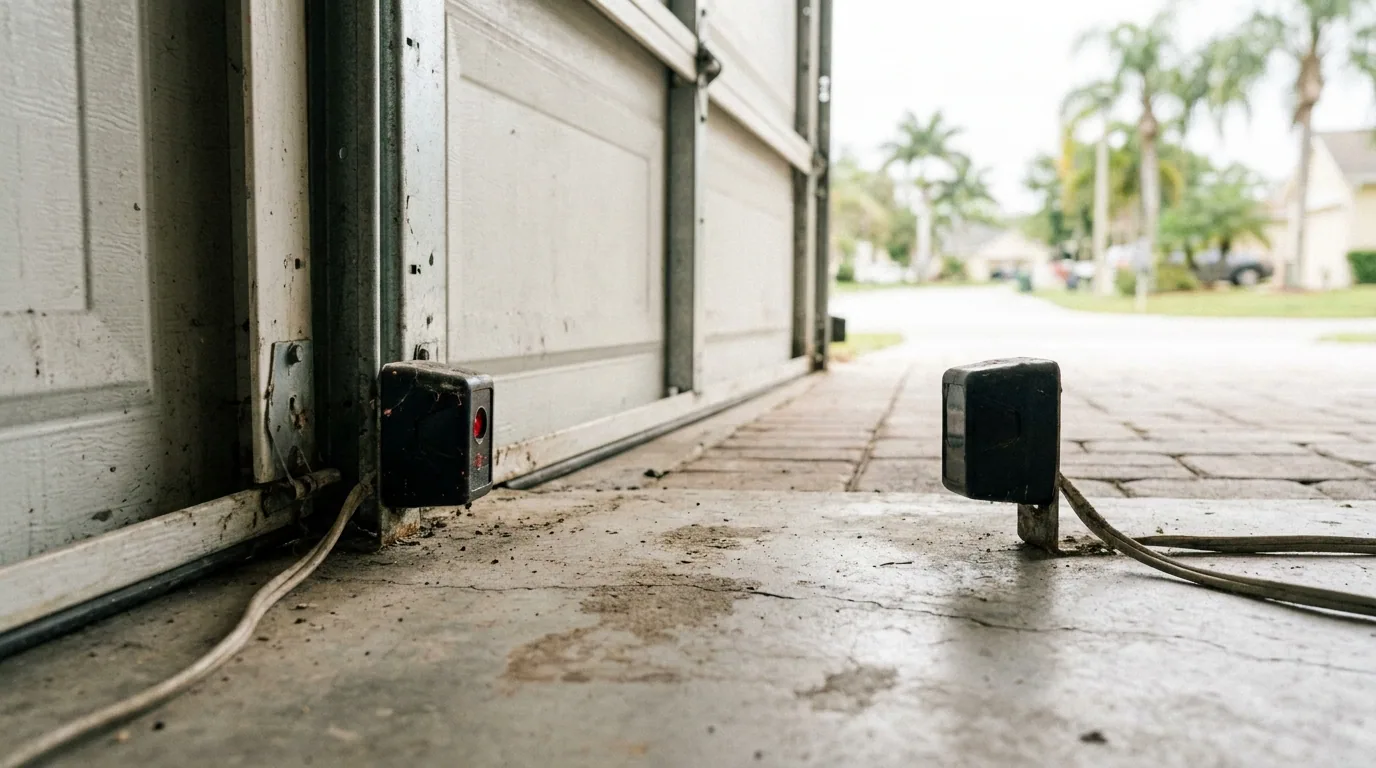
If the door reverses while it is closing, and only while it is closing, a blocked or misaligned photo-eye is a likely cause. The photo-eye is a pair of lenses near the floor that send a beam across the opening. If something blocks the beam — a stored item, a pet, a sagging lens — the door reverses as a safety measure. Clear the area in front of the lenses and confirm they are aligned.
If the door reverses before it reaches the floor, or opens a little and then reverses, the photo-eye is not the explanation. That pattern points to a travel-limit or force setting that needs adjustment, which is technician work.
What to tell the technician
When you call, the details you gathered at the start save time. Tell them whether the opener was silent, clicked, hummed, or ran without moving the door. Tell them whether the door felt heavier than usual, sat crooked, or showed a gap along the top. Tell them whether the door reversed while closing or before it reached the floor. Those observations separate a power problem from a dead opener from a spring or cable failure, and they help the technician arrive with the right parts and the right plan.
CrownLift Garage Doors serves Broward County, Florida, including Hollywood, Fort Lauderdale, Hallandale Beach, Dania Beach, Davie, Pembroke Pines, Miramar, Weston, Sunrise, Plantation, Cooper City, Southwest Ranches, West Park, Pembroke Park, Aventura, and North Miami Beach. The company is licensed and insured. Weekday hours are 7:00 AM to 8:00 PM, weekend hours are 8:00 AM to 6:00 PM, and emergency service is available. Call (877) 897-6132 or email service@crownliftgarage.com.