Most homeowners pay no attention to the springs above the garage door until the door stops behaving. Then the door won't lift, or it comes down faster than it should, or there is a bang from the garage and the door suddenly feels much heavier on the way up. At that point the spring is the center of attention, and the first useful question is which kind of spring system is actually on the door. In Broward County the housing stock is varied, from older homes in Hollywood and Dania Beach to newer construction in Weston, Miramar, and Pembroke Pines, and both designs are common across the area. Identifying yours tells you what a repair involves and why the two systems are serviced differently. It does not change where your work stops. Springs are under heavy tension at all times, and winding, adjusting, or removing one is technician work. What follows is about recognizing what you have and understanding what you are seeing.
The two systems, and how to tell them apart from the garage floor
Nearly every residential door in the region uses one of two counterbalance designs. You can usually identify yours with the door closed, standing in the garage, without touching any hardware.
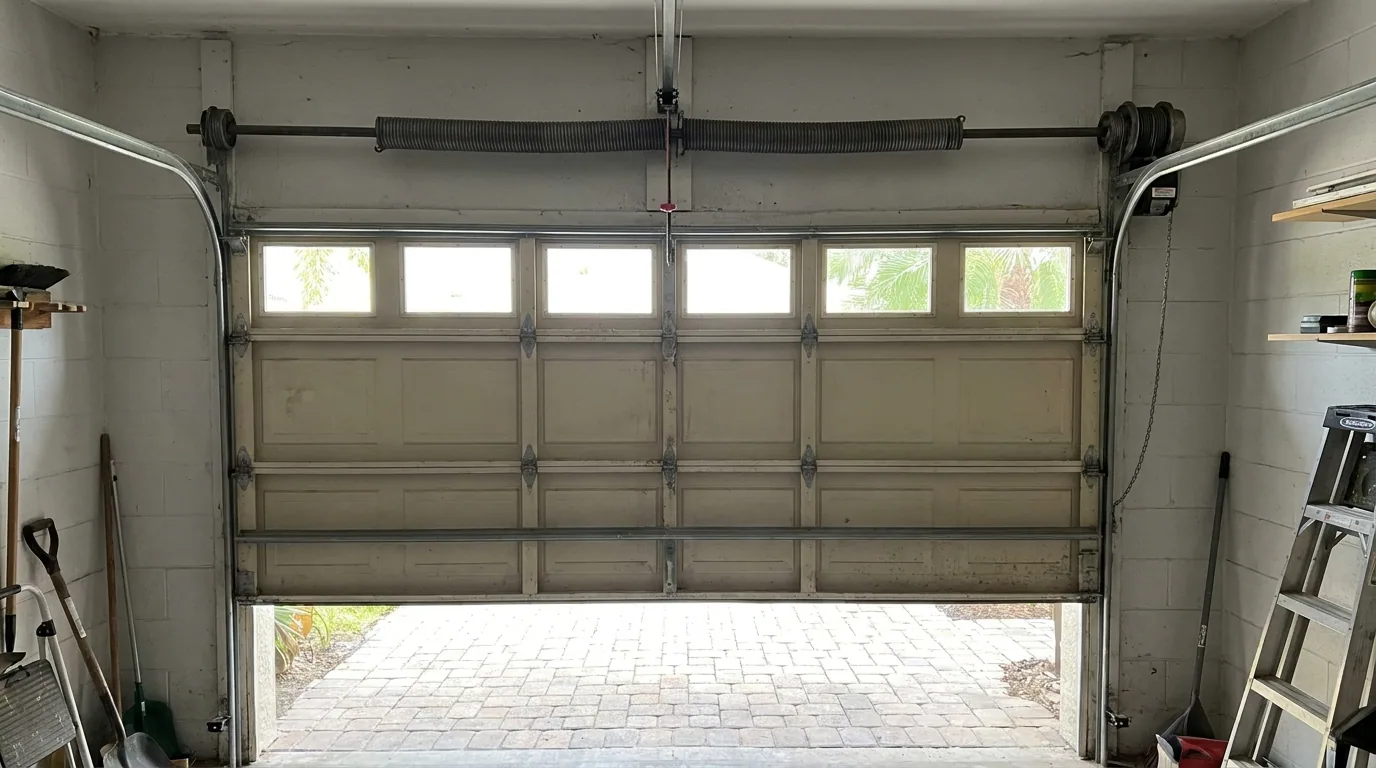
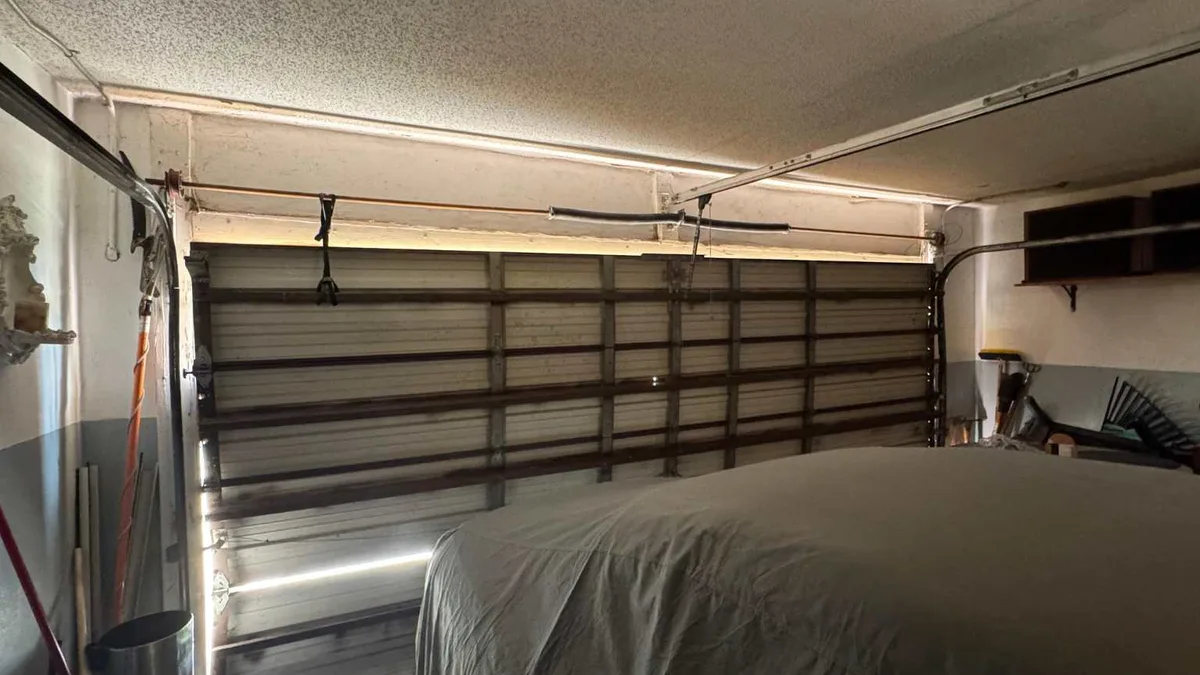
Torsion springs are mounted horizontally on a steel shaft that runs across the wall above the door. The coil is wound around that shaft, usually off to one side or centered, and it sits above the door opening rather than beside the tracks. On a two-car door you will often see two torsion springs on the same shaft. The shaft connects to drums at each end, and cables run from those drums down the sides of the door.
Extension springs are mounted along the horizontal tracks on each side of the door, running from a bracket near the front of the track toward the rear. They sit beside the door rather than above it, stretching as the door closes and contracting as it opens. Many extension systems have a cable running through the center of the spring as a safety measure.
If you see a coil above the door on a shaft, it is torsion. If you see springs running alongside the tracks at door height, it is extension. That is the whole test, and it requires no tools and no contact with the hardware.
Why the distinction matters at repair time
The two systems store energy differently, and that shapes what a repair actually involves.
A torsion spring is wound around a shaft and held under tension by set screws and winding hardware. Replacing one means the technician releases that stored energy in a controlled way, removes the old spring, installs the new one, and winds it to the correct number of turns for the door's weight. The cables, drums, and shaft are all part of that job, and the technician checks them while the system is open. Because torsion springs are commonly installed in pairs on two-car doors, a technician will often discuss replacing both at once, since matched springs wear at the same rate.
An extension spring stretches along the track and is held by brackets at each end. Replacing one involves relieving the tension, swapping the spring, and confirming the door travels evenly afterward. Extension systems have their own wear points, including the pulleys and the safety cables that run through the springs, and a technician checks those as part of the repair.
The practical difference for you is what has to be opened up and checked. A torsion repair involves the shaft, drums, and cables above the door. An extension repair involves the tracks, pulleys, and end brackets. Both require the door to be secured and the tension released in sequence, which is exactly why neither is a homeowner task.
What a spring problem looks like from outside the door
You do not need to identify a broken spring by looking at it. The door tells you. Here are the symptoms worth noting, and what each one can mean.
The door feels much heavier in normal use
If the door used to lift easily and now feels like it is fighting you, the counterbalance has lost strength. On a torsion system, a broken spring cannot hold the door's weight, so the opener or the person lifting it is doing all the work. On an extension system, a failed spring leaves that side of the door without counterbalance. Either way, the door will feel heavier when you use it normally. Stop running it and have a technician check the springs and cables. Do not try to lift the door by hand to test it, and do not pull the emergency release to move the door manually. Both put you under a load you cannot safely control.
The door hangs crooked
A door that sits at an angle, one side higher than the other, can have several causes. A snapped cable will let one side drop. A broken spring on one side of a two-spring system will do the same. A bent track can also make the door travel unevenly. The way to tell them apart is for a technician to check the cables, springs, and track together. From the driveway, note which side is low and whether the door makes a new noise on that side, and pass that along when you call.
There is a bang from the garage
A sharp bang followed by a door that will not lift is the classic sound of a torsion spring breaking. It is a sudden failure, not a gradual one, and the door should be left closed until a technician arrives. Extension springs can fail suddenly as well, which is why safety cables are standard on those systems.
The door opens a little and then reverses
This is a travel-limit or force-setting issue, not a photo-eye problem. A photo-eye is a safety device that reverses a door while it is closing, and only while it is closing. If the door reverses before it reaches the floor on the way down, the opener's travel limits or force settings need attention. If it reverses on the way up, that is a different issue again. Either way it is an opener adjustment, and the technician will check the springs as part of the diagnosis, since a door that is out of balance can trigger the opener's force sensor.
Maintenance that keeps either system working longer
Springs wear by cycle count, not by calendar age. Every open and close is one cycle, and a household that comes and goes several times a day will wear a spring faster than one that uses the door twice a day. You cannot change that math, but you can keep the rest of the system from adding strain.
- Keep the door balanced. A door that is out of balance makes the springs and opener work harder. If you notice the door feeling heavier or traveling unevenly, have it checked rather than waiting for a failure.
- Keep the tracks clean. Debris in the tracks adds friction, and friction is what the springs and opener have to overcome. Wipe the tracks down and remove anything that has fallen in.
- Listen for new noises. A squeal or grind at the start of a cycle can come from a roller, a hinge, or a dry bearing. Note when it happens and mention it when you call. A technician can identify the source.
- Watch the door's travel. A door that is starting to sit crooked or close unevenly is telling you something is changing. Have it checked before it becomes a failure.
What you should not do is lubricate, adjust, or otherwise handle the springs themselves. The tension in a wound torsion spring or a stretched extension spring is not something to work around, and the set screws and brackets that hold them are under load. That work belongs to a technician.
When to call, and what to tell us
If the door will not lift, hangs crooked, feels heavier than it used to, or made a bang, stop using it and call CrownLift Garage Doors at (877) 897-6132. We serve homeowners and light commercial properties across Broward County, including Hollywood, Fort Lauderdale, Hallandale Beach, Dania Beach, Davie, Pembroke Pines, Miramar, Weston, Sunrise, Plantation, Cooper City, Southwest Ranches, West Park, Pembroke Park, Aventura, and North Miami Beach. We are licensed and insured, and we handle garage door springs, repairs, openers, new installation, replacement, and commercial doors.
When you call, the most useful things to have ready are the symptoms you have noticed, whether the door is torsion or extension, and whether the door is currently stuck open or closed. That last detail matters for how the visit is scheduled. You can also reach us at service@crownliftgarage.com or at 2350 NW 66th Ter, Hollywood FL 33024. Weekday hours are 7:00 AM to 8:00 PM, weekend hours are 8:00 AM to 6:00 PM, and emergency service is available.
One last note on the two systems: neither is inherently better, and the right one for a given door depends on the door's size, weight, and how it was engineered. What matters is that the system on your door is matched to the door and in good repair. If you are unsure which type you have, the technician can tell you at the visit, and that identification is the first step in any spring repair.