A garage door usually tells you something is wrong before it stops working entirely. The trouble is that the early signs are quiet enough to live with — a new sound at the start of a cycle, a door that sits slightly crooked, a remote that needs a second press from the driveway. Living with them is what turns a small repair into a larger one. What follows separates the symptoms that mean stop running the door today from the ones worth writing down and watching, using causes that are mechanically certain. Where several things could explain what you are seeing, we describe how to tell them apart. The springs, cables, and opener drive train are technician work throughout; what you can safely do is observe the door from the driveway with the garage empty.
Stop using the door today
These are not gradual. When one of them shows up, leave the door where it is and call CrownLift Garage Doors at (877) 897-6132. Running it further risks the door coming down hard, leaving its tracks, or taking the opener out along with the original problem.
The door hangs crooked
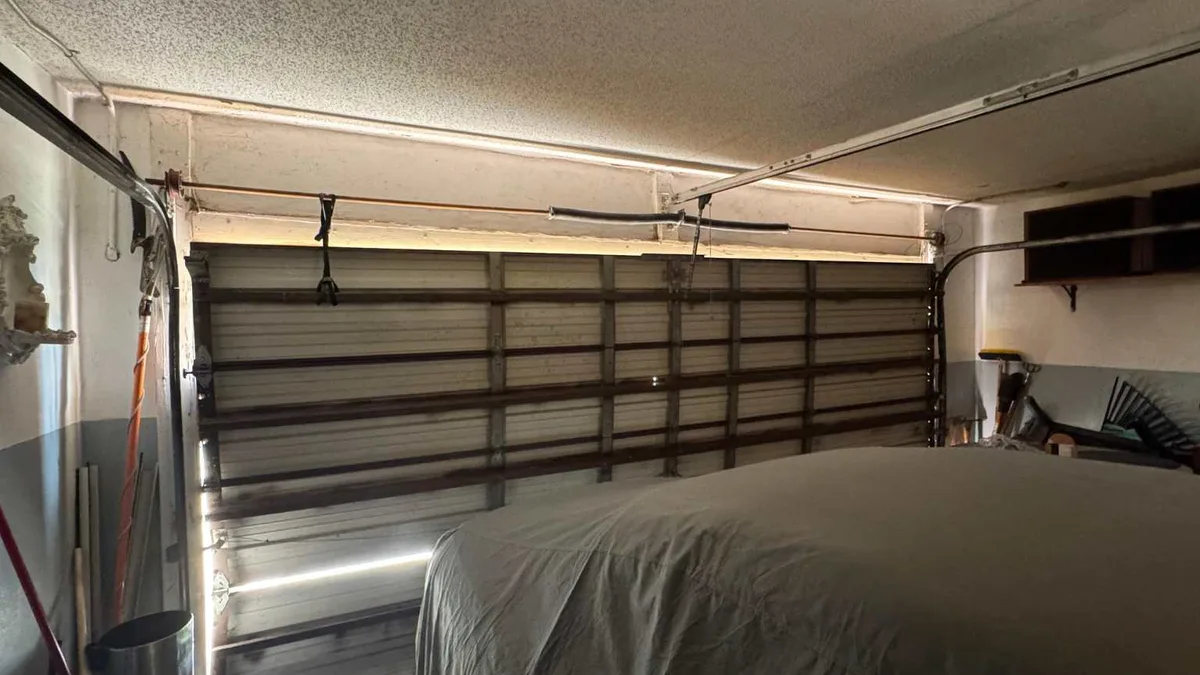
Watch the door from the driveway as it travels. If one side climbs faster than the other, or the door finishes a cycle visibly tilted, a cable has snapped or come off its drum. This is certain: the cables tie the bottom corners of the door to the drum above, and a door with a snapped cable hangs at an angle because one side is no longer being pulled. A broken torsion spring can produce a similar look, and so can a bent track, so the technician confirms which by inspecting the cables, springs, and track together. What you do not do is run the door to see whether it straightens out. A door traveling crooked can jump its track and come down.
A loud bang from the garage, then a door that will not open
A torsion spring that breaks makes a sharp report — many homeowners describe it as sounding like a gunshot from the garage — and after that the door will not lift, or lifts a few inches and stops. This is mechanically certain: a broken torsion spring cannot hold the door's weight, and the opener is not built to lift the full weight of the door on its own. If you heard the bang and the door is now dead, stop. Do not keep pressing the remote, and do not let anyone stand under the door. The spring is the part that failed, and it is not a part a homeowner should touch.
The door is off its track
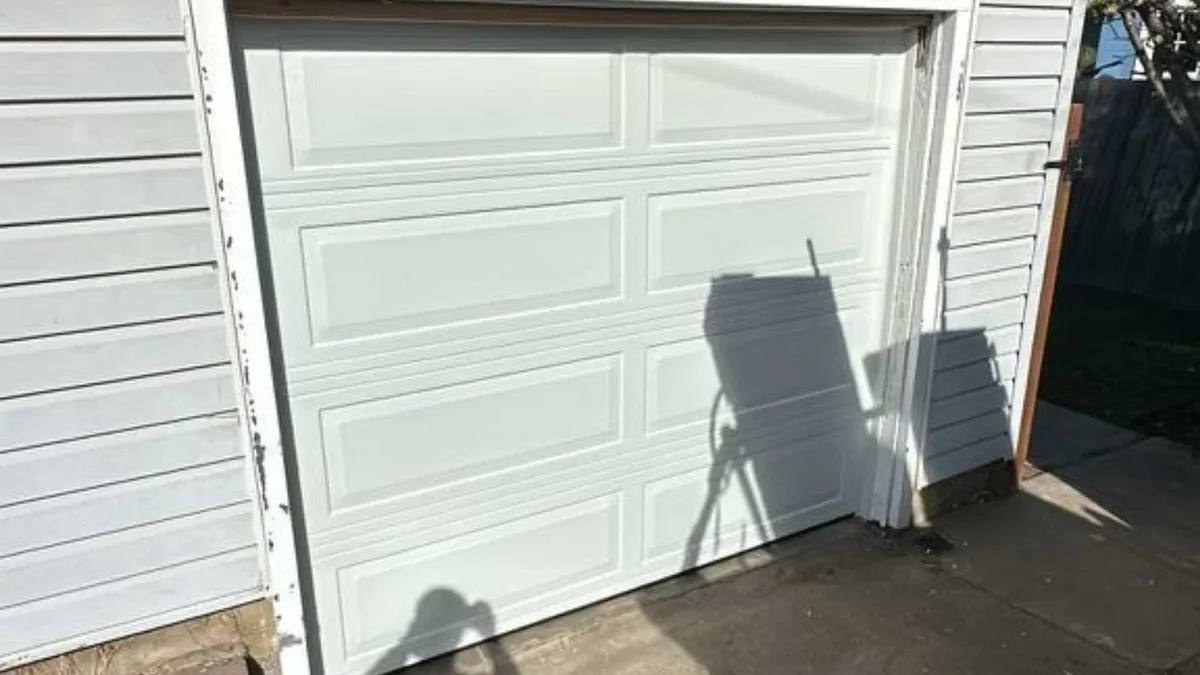
A roller that has left the track, or a track that has bent, leaves the door hanging at an odd angle or jammed partway. This is visible from the driveway and it is a stop-now condition. Forcing the opener to run against a jammed door strips gears and can bend panels. Leave it and call.
Notice and watch
These symptoms are worth writing down and watching for a few days. None of them means the door is about to fall, but each one points to a part that is wearing and will get worse.
The door feels heavier than it used to
If the door seems to need more effort from the opener than it did a few months ago — it moves slower, the motor sounds labored, or it hesitates at the start of a lift — the counterbalance has likely lost some of its strength. A torsion spring that is fatigued rather than broken still holds part of the weight but not all of it, and the opener makes up the difference until it can't. Do not test this by lifting the door by hand or by pulling the emergency release and moving it. That is technician work. Note what you are seeing and have the springs evaluated.
A new noise at the start of a cycle
A squeal, a grind, or a rattle that was not there before has several possible sources: a dry or worn roller, a hinge that has lost its lubrication, a bearing at the end of the torsion shaft, or a loose fastener somewhere on the door. The sound alone does not identify which. A technician separates them by running the door and listening at each component, which is faster than guessing. What you can do is note when the noise happens — at the very start, only on the way up, only on the way down, or throughout — because that narrows the list before anyone arrives.
The door reverses before it reaches the floor
This one is often blamed on the photo-eye, and usually wrongly. A blocked or misaligned photo-eye reverses a door that is closing, and only while it is closing — it is a safety device on the down travel. If your door starts down, stops partway, and goes back up without anything in the opening, the cause is more likely a travel-limit setting or a force setting on the opener that needs adjusting. If the door reverses only when something is actually in the path of the beam, the photo-eye is doing its job and the alignment or the obstruction is the issue. Either way, this is an opener adjustment, not a spring or cable problem, and it belongs to a technician.
The opener motor runs but the door does not move
When you hear the motor humming and nothing happens, a stripped gear inside the opener is one certain possibility: the gear that couples the motor to the drive lets the motor spin without moving the chain, belt, or screw. It is not the only possibility. A broken spring, a snapped cable, or a door jammed in its track will also leave the motor running against a door that will not move. The test that separates them is whether the drive mechanism itself moves — a technician checks that. From the driveway, note whether the door moves at all or moves a few inches and stops, and whether the motor sound is normal or strained.
A gap along the top or a draft you did not have before
A door that closes but leaves a visible gap along the top, or one corner that does not meet the floor, is usually a travel-limit or track problem rather than a failed spring. It is worth watching for a few days, especially if it appeared after the door was bumped or after a storm. A persistent gap lets water and pests in, and in South Florida that matters more than it does in drier climates. Have it corrected rather than living with it.
What a technician actually checks
When you call, the technician inspects the springs and cables, checks the track alignment and the rollers, tests the opener's force and travel settings, and confirms the safety reverse works. That is the part homeowners should not do themselves: the springs and cables are under tension, and the opener drive train has moving parts that can injure a hand. What you can do before the visit is write down what you have noticed — when the noise happens, whether the door is crooked, whether the motor runs without moving the door, and how long it has been going on. That short list saves time on the diagnosis.
Maintenance that prevents the call
Most of the failures above are wear, not accidents. A door that gets looked at once a year lasts longer than one that only gets attention when it stops. The maintenance a technician performs — lubricating rollers and hinges, checking spring tension and cable condition, tightening fasteners, and confirming the opener's settings — is the work that keeps a door out of the stop-now category. For light commercial doors, the same logic applies with more cycles per day, so the interval between checks should be shorter. If your door is in Hollywood, Fort Lauderdale, Hallandale Beach, Dania Beach, Davie, Pembroke Pines, Miramar, Weston, Sunrise, Plantation, Cooper City, Southwest Ranches, West Park, Pembroke Park, Aventura, or North Miami Beach, CrownLift Garage Doors handles garage door repairs, springs, openers, and new installation across Broward County. Call (877) 897-6132 or email service@crownliftgarage.com. The company is licensed and insured, and emergency service is available.