A garage door stuck open is a nuisance in daylight and a different problem after dark. The opening is unsecured, the house is exposed, and whatever is inside the garage is visible from the street. The instinct is to force the door down or start taking things apart. Neither is a good idea. What follows is the order that actually works: secure the opening first, gather a few observations while the door is still in the position it failed in, and then decide whether this is a reset or a repair. Springs, cables, and the opener drive train stay with a technician throughout. Everything below is about the door as a whole and what you can safely see and hear from outside it.
Secure the opening before you troubleshoot anything
If the door is fully open and staying there, the first job is closing off the space, not diagnosing it. Close and lock the door between the garage and the house if there is one, and treat the garage as outside until the overhead door is down. Move anything valuable or easy to carry out of sight. If the garage has a side entry door, lock it. If it does not, a temporary barrier across the opening is worth the effort for one night.
If the door is partway open, do not stand under it and do not try to push it down. A door that has stopped mid-travel is being held by whatever is left of its lifting system, and adding your weight to it is how people get hurt. Keep people and vehicles clear of the opening and call for service.
CrownLift Garage Doors covers Broward County and offers emergency service. The number is (877) 897-6132, and the email is service@crownliftgarage.com. Weekday hours are 7:00 AM to 8:00 PM and weekend hours are 8:00 AM to 6:00 PM, with emergency service available outside those times.
Write down what the door did, while you still remember
The most useful thing you can hand a technician is an accurate account of the failure. Before you touch the wall button again, note a few things:
- Did the door stop on the way up, or did it go all the way up and then refuse to come down?
- When you press the button, do you hear the motor running with no movement, or is there no sound at all?
- Is the door sitting level, or is one side visibly lower than the other?
- Is there a gap along the top of the door that was not there before?
- Did anything change in the last day — a power interruption, a storm, a new noise at the start of a cycle?
Those five answers separate most causes before anyone arrives. A door that is visibly crooked points in a different direction than a door that is level and simply will not move.
Match the symptom to the likely cause
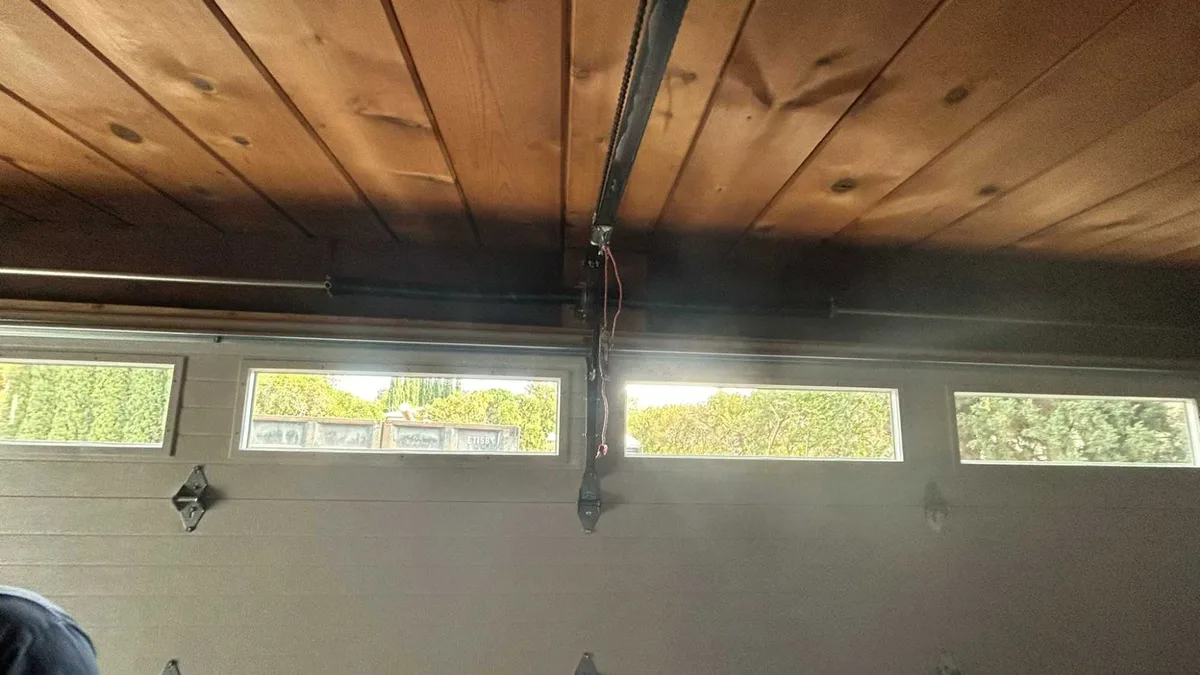
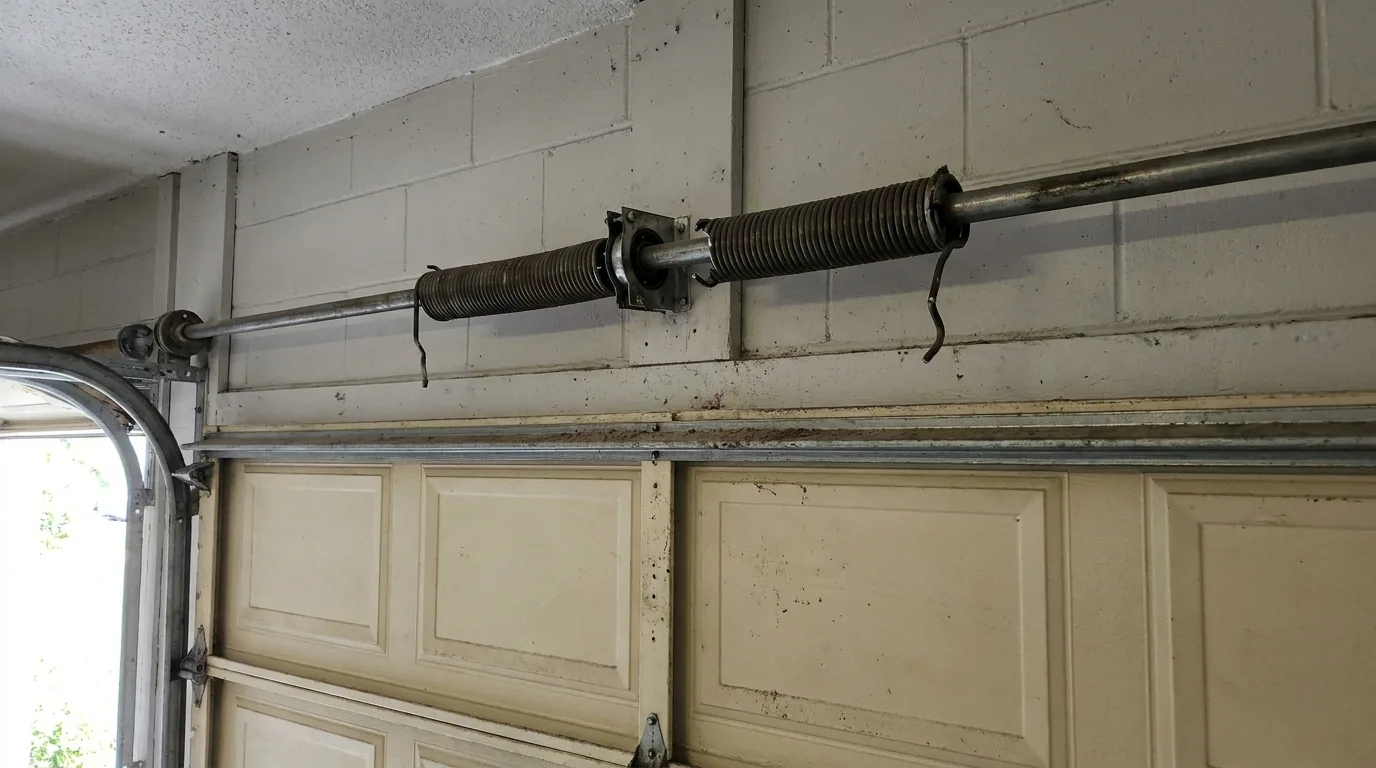
A motor that runs but does not move the door has a short list of possibilities. A stripped opener gear lets the motor turn without engaging the trolley, which is one common reason. A broken torsion spring cannot hold the door's weight, so the opener may strain and stall. A snapped cable lets one side of the door drop, which usually shows as a door hanging at an angle. These look similar from the driver's seat and are told apart by a technician at the door.
A door that is visibly crooked is not a single-cause symptom. It can mean a snapped cable, a broken spring, or a bent track, and the correct move is to have all three checked rather than to assume one. Do not try to straighten the door by hand.
If the door will not start at all and the motor is silent, the cause is often electrical rather than mechanical: a tripped breaker on the circuit feeding the opener, a wall button that has failed, or a remote with a dead battery. Those are safe to check yourself. A door that opens a little and then reverses before reaching the floor is a travel-limit or force-setting problem, not a safety-sensor problem — the photo-eye only reverses a door that is closing, and only while it is closing.
What you can safely reset, and what you should not
There are a few things a homeowner can do without risk. Check the breaker panel for a tripped circuit to the opener. Try the wall-mounted button as well as the remote, since one working and the other not tells you where the problem sits. If the opener has a battery backup, confirm it has not been switched off. If the door is fully closed and the opener light is flashing in a pattern, the opener is reporting a fault code, and that code is worth writing down for the technician.
What you should not do is more important. Do not pull the emergency release and try to move the door by hand. Do not attempt to lift the door to judge its weight. Do not touch the torsion spring, the cables, or the opener drive train. A torsion spring under tension holds the full weight of the door, and a cable under load can cause serious injury. These are technician work, and the reason is not caution for its own sake — it is that the stored energy in those parts does not announce itself.
When to call it in rather than wait for morning
If the opening can be secured — the door is fully down, or the garage can be locked off from the house and the street — waiting for a scheduled visit is reasonable. If the door is hanging partway open, if it is crooked, if you heard a bang from the garage and the door will not move, or if the opening cannot be closed off at all, call for emergency service rather than leaving it overnight.
CrownLift Garage Doors is licensed and insured and serves Hollywood, Fort Lauderdale, Hallandale Beach, Dania Beach, Davie, Pembroke Pines, Miramar, Weston, Sunrise, Plantation, Cooper City, Southwest Ranches, West Park, Pembroke Park, Aventura, and North Miami Beach. The address is 2350 NW 66th Ter, Hollywood FL 33024. When you call, have your notes from the failure ready — what the door did, what you heard, and what you have already tried. It shortens the visit and gets the opening closed sooner.