A garage door does not wear out on a calendar. It wears out on cycles, and a cycle count in South Florida looks different from a cycle count almost anywhere else. A door that runs four times a day in a household where everyone drives has a very different service life from a door that runs twice a day, and the humidity, salt air, and afternoon heat of Broward County add wear that a manufacturer's generic schedule does not account for. The question worth asking is not "how many months has it been?" but "how much work has this door done, and under what conditions?" What follows is how to think about the interval, what a routine service visit actually covers, and the between-visit signs that mean you should not wait for the next one. Springs, cables, and the opener drive train stay with a technician throughout; everything here is about the door as a whole and what you can safely see and hear from outside it.
Start with cycles, not months
Every open-and-close is one cycle, and every component on the door has a rated life measured in cycles. The torsion springs carry most of the door's weight and are the part most often described by a cycle rating, but rollers, hinges, bearings, and the opener's gears all accumulate wear the same way. A door used four times a day passes 1,460 cycles in a year. A door used twice a day passes 730. Same door, same neighborhood, half the wear.
That is why a fixed number of months is a rough guide at best. A reasonable way to set your own interval is to count the cycles you actually put on the door in a typical week, then think about the total rather than the elapsed time. A household with two cars, a busy schedule, and a door that also gets opened for deliveries and yard work is doing meaningfully more work than a single-car household where the door runs twice a day. The heavier-use door should be seen more often, and the lighter-use door can stretch further.
For most residential doors in Broward County, a routine service visit once a year is a sensible baseline, and a door that runs heavily is better served at roughly twice that frequency. Light commercial doors, which cycle far more often than a home door, should be on a shorter interval still. Those are starting points, not rules. The between-visit signs below are what tell you whether your particular door needs more attention than the baseline suggests.
Why the coastal climate matters
Broward County is warm and humid for most of the year, and the air carries salt near the coast. That combination affects a garage door in ways that a service schedule written for a dry climate does not anticipate. Lubricant on the moving parts does not stay where it was applied as long as it would in cooler, drier air. Rollers and hinges that would otherwise turn freely can stiffen. Fasteners and the metal of the track and hinges are exposed to moisture and salt on a daily basis, which is the environment in which corrosion begins.
None of this means a South Florida door is failing constantly. It means the parts that benefit from cleaning and lubrication benefit from it more often here, and that a technician looking at the door once a year has more to check than a technician in a milder climate. A routine visit in this region is partly a lubrication and adjustment service and partly an early-warning inspection for corrosion and stiffness before they turn into a repair.
What a routine service visit actually covers
A service visit is not the same as a repair call. It is a scheduled pass over the whole system, and it is worth knowing what should be included so you can tell whether the visit was thorough.
- Lubrication of the moving parts. Rollers, hinges, and bearings get cleaned and lubricated. This is the single most effective thing you can have done on a regular basis, and it is the part most affected by the local humidity.
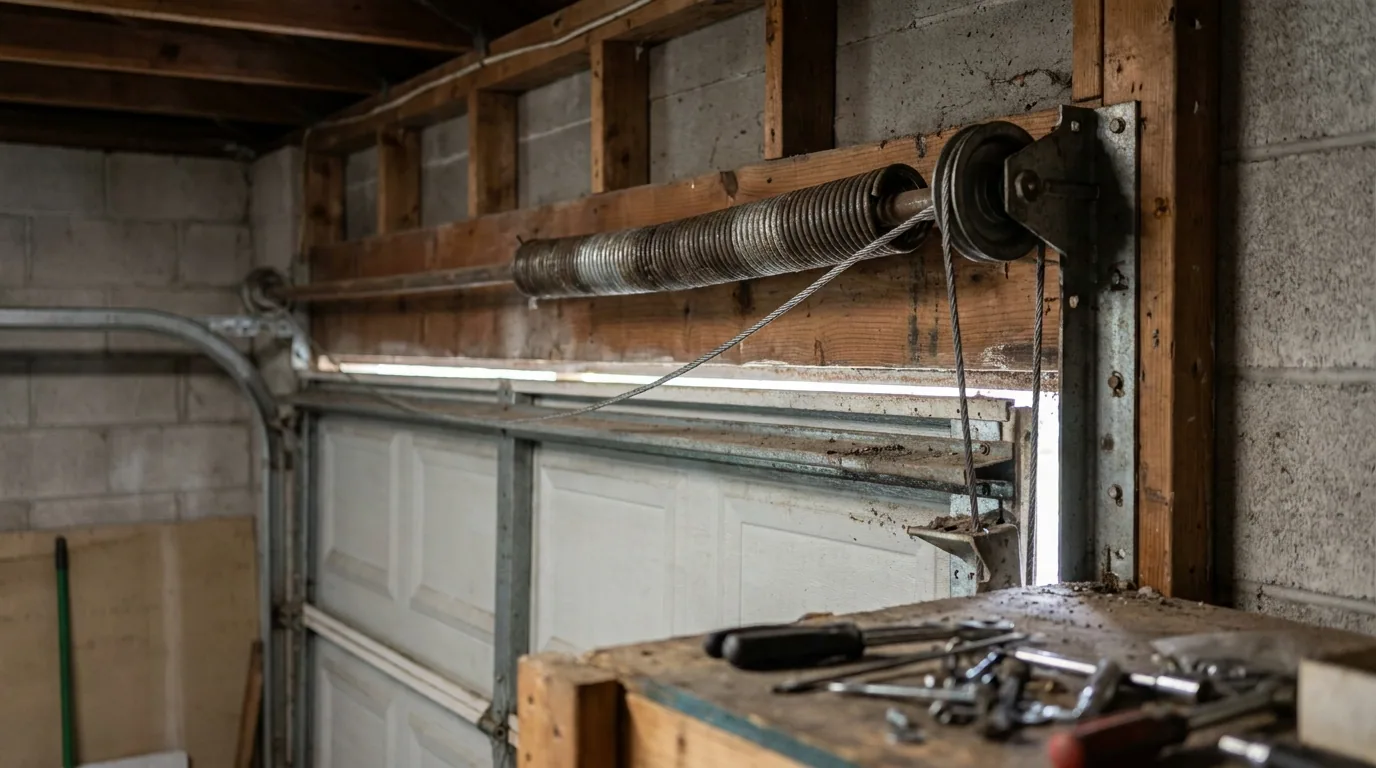
- Springs and cables. The technician inspects the torsion springs and the cables for wear and for the early signs of failure. This is technician work; it is not something a homeowner should be checking.
- Track alignment and hardware. The track is checked for bends, loose fasteners, and misalignment, and the door's hardware is tightened and adjusted as needed.
- Door balance and travel. The technician checks that the door is balanced and that it travels fully open and fully closed, and adjusts the opener's travel limits and force settings if they have drifted.
- Safety devices. The photo-eye and any other safety features are checked to confirm they are working as intended.
- The opener. The motor, drive train, and mounting are checked, and the technician listens for the noises that suggest a part is on its way out.
What a service visit is not is a guarantee that nothing will break. It is a chance to catch wear before it becomes a failure, and to keep the door running smoothly between visits. CrownLift Garage Doors offers garage door repairs and services openers and springs, and a routine visit is the point at which small adjustments are made before they turn into a repair call.
Signs you should not wait for the next visit
The baseline interval assumes the door is behaving normally. When it is not, the schedule stops mattering and the symptom takes over. The signs below are the ones worth acting on, and each is something you can notice from outside the door without touching the springs, cables, or opener drive train.
The door sits crooked, or hangs at an angle
A door that is visibly crooked, with one side higher than the other, can mean a snapped cable, a broken spring, or a bent track. Those are three different repairs, and the way to tell them apart is for a technician to inspect the springs, cables, and track directly. Do not try to work out which one it is by moving the door yourself. Stop using the opener and call for service.
The door feels heavier than it used to
If the door feels heavier when you use it normally, the springs may no longer be carrying their share of the weight. That is a spring problem, and springs are technician work. A door that has become noticeably harder to operate is also harder on the opener, so continuing to run it can turn one repair into two.
A new noise at the start of a cycle
A squeal, a grind, or a rattle that was not there before can come from a roller, a hinge, or a dry bearing. It can also come from the opener. Those possibilities are separated by a technician inspecting the door and the opener together, not by guessing from the sound alone. A noise that appears only at the start of a cycle, or only in the morning, is worth mentioning when you call, because the timing helps narrow it down.
The door reverses before it reaches the floor
A door that reverses before it reaches the floor is usually a travel-limit or force-setting problem, not a photo-eye problem. The photo-eye is a safety device on the closing travel: a blocked or misaligned photo-eye reverses a door that is closing, and only while it is closing. It has no role in a door that will not start, opens a little and then reverses, or stops short. If your door reverses before reaching the floor, describe exactly when it happens when you call, because the timing is what points to the cause.
The opener runs but the door does not move
If you hear the motor running and the door stays put, a stripped opener gear is one possible reason, but it is not the only one. The drive train, the door's connection to the opener, and the door's own condition all bear on whether the door moves when the motor turns. A technician can tell which of these is the cause. Do not pull the emergency release and try to move the door by hand to test it.
The door will not close, or stops partway
A door that stops partway on the way down, or refuses to close at all, can be a travel-limit setting, a force setting, or a problem with the door's movement. It is not automatically a photo-eye issue, and it is not automatically a spring issue. The technician's inspection separates them. In the meantime, keep the opening secured and treat the garage as outside until the door is working again.
Setting an interval that fits your door
The practical answer for most homes in Broward County is a routine service visit once a year, with a shorter interval for doors that cycle heavily and for light commercial doors. If your door is older, has been repaired before, or has shown any of the signs above, the next visit should come sooner rather than later. The best way to set the interval is to have the door looked at once, learn what condition it is in, and let the technician tell you what schedule fits the wear actually present.
If you are not sure when your door was last serviced, or you have noticed one of the signs above, CrownLift Garage Doors serves Hollywood, Fort Lauderdale, and the surrounding communities in Broward County. You can reach the team at (877) 897-6132 or service@crownliftgarage.com. The company is licensed and insured, and emergency service is available. A service visit is a chance to catch wear early; the signs above are the reason not to wait for the calendar when the door is telling you something else.