A garage door that hangs lower on one side than the other is one of the more common things homeowners call about, and it is also one of the more informative symptoms a door can give you. The door is a rigid set of panels riding on two tracks, lifted by springs and kept level by cables running down each side. When one corner drops, something in that arrangement has changed. The trick is that a crooked door has several possible causes, and they are not equally urgent. What follows is what you can safely observe from outside the door with the garage empty, and how a technician sorts the likely causes once he is on site. Springs, cables, and the opener drive train are under load and stay with a technician throughout.
What a sagging door looks like from the driveway
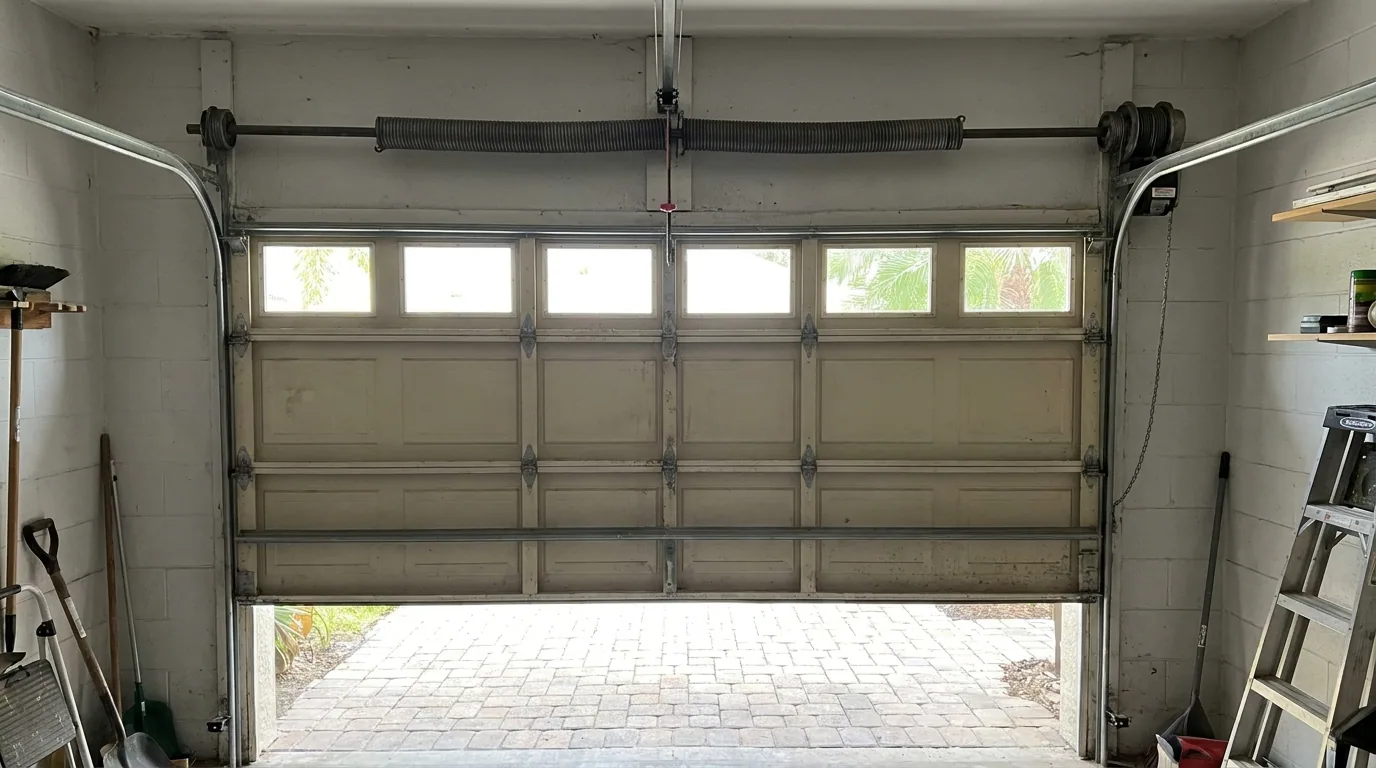
Stand back far enough to see the whole opening. A door that is level shows an even line across the top and a bottom edge parallel to the floor. A sagging one shows a wedge along the top — tight on one side, open on the other — and the gap often grows as the door travels. You may also notice that one side of the door sits proud of the other when it is fully closed, or that the door rattles against one jamb on its way up.
It helps to note when the crookedness appears. A door that hangs level when closed but rises unevenly is a different problem from one that is crooked in every position. Note whether the door still opens and closes completely, whether a new noise comes from one side, and whether the door feels heavier than usual in normal use. Those details are genuinely useful to whoever comes out.
The three causes worth knowing about
A door that hangs at an angle has three broad explanations, and each behaves a little differently.
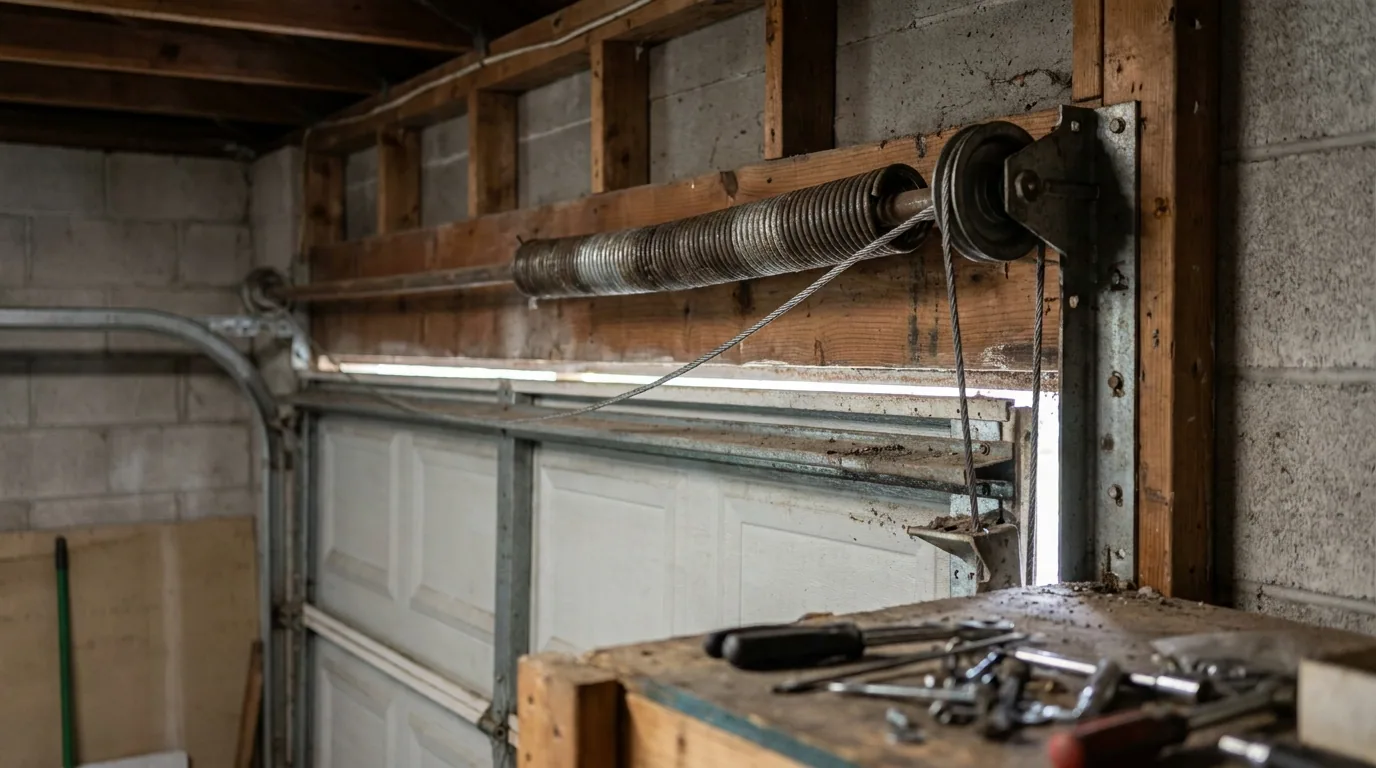
- A snapped cable. The cables run down each side of the opening and keep the two sides of the door moving together. When one lets go, that side loses its support and the door hangs at an angle. A snapped cable is a certain cause of a crooked hang — if the cable is broken, the door will sit crooked, and it is not safe to operate.
- A broken torsion spring. On a two-spring setup, each spring carries one side of the door. A broken torsion spring cannot hold the door's weight, so the side it serves loses its lift. The door may still open, but it will feel heavy and it will not sit level.
- A bent or misaligned track. If a track has been knocked out of line — by a car bumper, a ladder, or a door that has jumped its rollers — that side of the door cannot travel properly and the door sits crooked. This one is often visible from the floor as a track that is no longer straight or plumb.
None of these can be confirmed from the driveway alone, and that is the point. A technician separates them by checking the springs, the cables, and the track alignment directly, and the fix differs for each. A snapped cable and a broken spring are both urgent; a bent track may be a simpler correction.
Why the springs are the part to take seriously
On most sectional doors, the springs are what actually hold the door's weight. The opener only supplies the push and pull to move it; the springs make the door light enough for the opener, or for a person, to lift. When one spring fails, the door's weight shifts onto the other spring and onto the cables, and the door will feel considerably heavier in normal use. That imbalance is what shows up as a sag.
This is also why a crooked door should not be cycled repeatedly while you wait for service. Running a door with a failed spring or a snapped cable puts load on parts that were not designed to carry it alone, and the door can come down hard or come off its track. If the door is crooked, leave it where it is and use another entrance if you can. If the door is the only way in or out of the garage, say so when you call.
What to gather before you call, and what to leave alone
There are a few safe things to collect. Confirm whether the opener still runs when you press the wall switch, and whether the door moves at all. Note whether the crookedness is constant or only appears during travel. Write down any new noise — a bang at the start of a cycle, a scrape on one side, a creak that was not there before. If the door is a commercial unit, note whether the problem affects one bay or several, and whether the door is used by customers or only by staff.
What you should not do is try to correct the imbalance yourself. Do not attempt to adjust, wind, or unwind a torsion spring, do not handle the cables, and do not pull the emergency release and move the door by hand to see how it behaves. Those parts are under heavy tension, and the door can shift suddenly. A technician has the tools to hold the door in position while the springs and cables are dealt with.
Getting it looked at
CrownLift Garage Doors serves homeowners and businesses in Hollywood, Fort Lauderdale, Hallandale Beach, Dania Beach, Davie, Pembroke Pines, Miramar, Weston, Sunrise, Plantation, Cooper City, Southwest Ranches, West Park, Pembroke Park, Aventura, and North Miami Beach, and the company is licensed and insured. If your door is hanging crooked, you can reach the office at (877) 897-6132 or service@crownliftgarage.com. Weekday hours are 7:00 AM to 8:00 PM, weekend hours are 8:00 AM to 6:00 PM, and emergency service is available. When you call, describe what you saw from the driveway — which side is low, whether the door still moves, and what it sounds like — and the technician will know what to bring.